-
https://link.springer.com/article/10.1007/s10212-020-00495-0
-
https://www.edapp.com/blog/nudge-theory-and-learning-tools/amp/
-
https://learn.filtered.com/thoughts/nudge-theory-engagement?hs_amp=true
-
https://www.td.org/atd-blog/the-neuroscience-of-the-learning-nudge
-
AskEARN | Inclusion@Work: A Framework for Building a Disability-Inclusive Organization
-
Implementing an Accessibility Policy: An Insider's Guide | EDUCAUSE
-
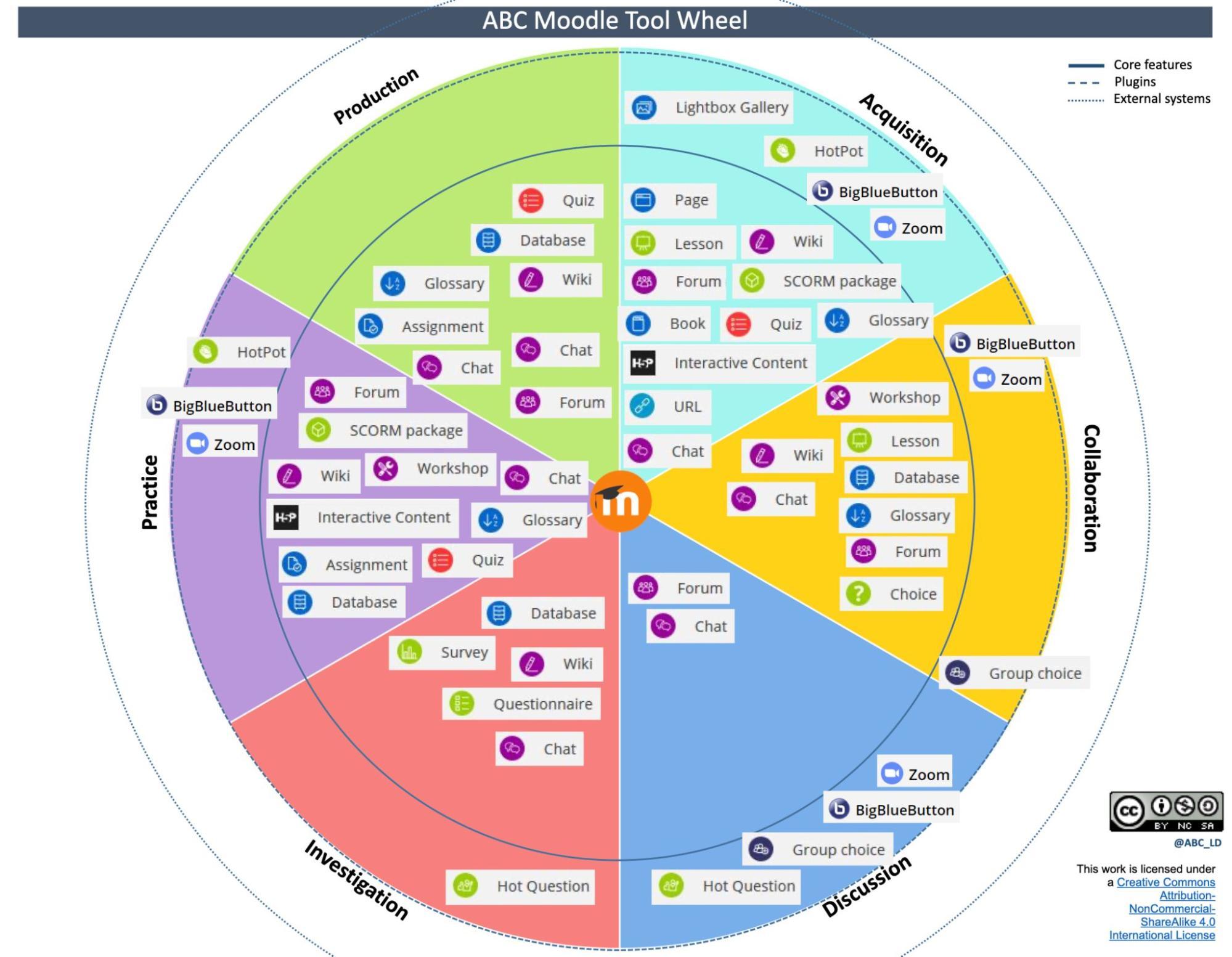
Designing engaging learning experiences with the ABC Learning Design method - Moodle
-
¿Cómo aplicar una estrategia de economía circular en mi ciudad?
-
Economía circular, ciudades circulares: una alternativa sostenible para América Latina y el Caribe
-
(6) (PDF) THE POWER OF NUDGING FOR VIRTUAL LEARNING ENVIRONMENTS
-
Nudge-Learning Strategy: Key Points To Consider - eLearning Industry
-
Helping the Poor in Education: The Power of a Simple Nudge - The New York Times
-
Nudge 2.0: A broader toolkit for lasting behavior change | HuffPost Latest News
-
How To Improve Student Outcomes By Adopting Nudges - eLearning Industry
-
Using Nudge Theory in Your Corporate Online Learning Classes - The Tech Edvocate
-
(3) Education 5.0: Rehumanising Education in the Age of Machines | LinkedIn
-
Don't give up on the nudge -- it can still help students (opinion)
-
How a strong nudge campaign can improve student outcomes during COVID (opinion)
- the concept of nudging -- low-cost, low-touch interventions aimed at driving people toward particular behaviors without mandating action or restricting options -- was a popular strategy with student support units across higher education.
- we in the New York University Office of Student Success believe that text message-based nudging, if done correctly and with an appropriate level of intention, can improve student outcomes.
- It can also increase levels of curricular and co-curricular engagement and, perhaps most important, increase student perception of support and connectedness during this challenging time.
- large text message-based nudge campaign that had two primary intentions
- The first and more prevailing was to send students passive content.
- Rather, we wanted to positively influence academic behavior over a prolonged period of time by sending students a series of quick tips that encourage behaviors that lead to academic and personal growth.
- Rather, their purpose was to subconsciously redirect students' attention at key moments during the academic semester
- The second intent was to give students an open channel of communication that allowed for individualized support opportunities.
- We saw the benefits of this particular campaign as multifold, including the ease of scalability, the relatively low cost (we worked with a third-party vendor for the technology component) and the ability to target at-risk student groups through real-time communication and interaction.
- a fall survey of nudge recipients showed that 94 percent of students said the texts made them feel like someone at NYU cared about their success, 95 percent said they felt comfortable reaching out for help, 96 percent said the texts made them feel more informed about university resources and 95 percent found text messaging to be an effective form of communication during remote learning.
- In interacting with our text message, many realized for the first time that a real person was on the other side -- someone who cared about their success and was available to chat, joke and let them vent their frustrations.
- By sending encouraging messages that reinforce positive academic habits and affirm belonging, we are finding that students perceive greater support from the university. As student support practitioners, is that not what we are here for?
- Reframe what you define as nudges and how to use them.
- Under this framing, email or text message reminders are often conceptualized as nudges, when in reality they are nothing more than traditional reminders.
- design your nudges based on behavioral psychology theory to gently encourage subtle changes in student behavior. The U.K. Cabinet Office’s Institute of Government in conducting in their MINDSPACE Approach provides a great framework
- Send nudges from a human, not a bot.
- two-way communication between your team and students
- While you will be sending these nudges to large groups of people at once, use a staff member’s name in the message and send a photo or other indication that a human being is directly communicating with students
- If you build a positive rapport with students through consistent, friendly and useful messaging, they will be more likely to pay attention to nudges
- Thus, peer-to-peer messaging may also be a useful strategy for a nudge campaign.
- Many of the earlier nudge campaigns worked because they were fairly intentional about whom they were nudging and when, as well as what behaviors they hoped to change
- Be intentional and specific.
- Pay attention to language and tone.
- The language should be persuasive and confident, not aggressive or pushy. Nudges should also be quite short -- fewer than 300 characters -- so be as direct and concise as possible without coming off as curt.
- Collaborate with campus partners. When nudging students, remember that they are interacting with a host of other campus partners.
- Also, when you use nudges as a way to drive students toward underutilized but important campus resources, always make sure you are not operating in isolation. You do not want to send a nudge to a large group of students reminding them of tutoring and academic support without first connecting with the team that provides that service
- Is text message-based nudging a magic bullet that can solve all of the issues facing higher education during this challenging period? No. But it can be an effective, scalable and efficient way to engage, support and encourage college students in this unprecedented time
-
Saturday, July 30, 2022
Weekly Sporto bookmarks (weekly)


Saturday, July 23, 2022
Weekly Sporto bookmarks (weekly)
-
A Rubric for Selecting Active Learning Technologies | EDUCAUSE
-
Micro-credentials: A Postdigital Counternarrative | SpringerLink
-
Success Strategies for Online Learners | Bridgewater State University
-
5 Ways to Promote Student Success in Online Learning -- Campus Technology
-
How to Succeed in Online Learning | Academic Support | Wright State University
-
5 Online Learning Tips for Student Success | Ohio State Online
-
How to Excel in Online Learning | Student Guide to Digital Classrooms
-
10 Tips for Success in Online Classes | College of Education | USF
-
Characteristics of a Successful Online Student | Fairmont State University
-
What Makes a Successful Online Student? | University of Illinois Springfield
-
Addressing The Needs Of The Online Learner - eLearning Industry
Saturday, July 16, 2022
Weekly Sporto bookmarks (weekly)
-
Learning Analytics 101 - Learning Analytics Research Network (LEARN) | NYU Steinhardt
-
A Design Research Methodology for Online Learning Course Design (#edumooc) – Rebecca J. Hogue
-
This Simple Nudge Can Get Students More Engaged in Online Courses | EdSurge News
-
- I would add a few more assumptions after connecting this with our experience (negative experience):- nudges should be early on (you should be getting students engaged as soon as they start, because this is when they are more enthusiastic)- nudges should be frequent (there should be a rhythm, so you have lots of opportunities to say something, and you can have a habit)- nudges should be short (they should not cost too much, otherwise they cannot work as nudges.)
- Although MOOCs have provided access to education for millions of learners, they are often criticized for their limited degree of engagement
- The statistics have been told and retold: 80 percent learners who enroll in a MOOC do not finish it, completion rates tend to be dismal, and interactions in discussion forums are usually one-way conversations.
- introducing and testing a novel approach for enhancing engagement in online courses
- So, traditional strategies that work in a physical classroom, such as discussions or ice-breaking activities, may or may not be effective in online environments
- We examined the effectiveness of various content-sharing strategies that nudge learners to either share something about their identity or about ideas related to the course.
- Our results showed that asking learners to share their ideas about the course leads to approximately a 30 percent increase in both video consumption and assessment completion
- why are idea-sharing nudges more effective for enhancing online learner engagement?
- Indeed, the idea advantage does not apply uniformly to all learne
- language fluency plays a more important role for idea sharing.
- idea-sharing nudges to engage learners in massive online classrooms
-
Saturday, July 9, 2022
Weekly Sporto bookmarks (weekly)
-
WebAIM: 8-Step Implementation Model - Introduction: Overview of a Model of Reform
-
Combine modules into a program with the subcourse plugin - Moodle
-
2022 EDUCAUSE Horizon Report | Teaching and Learning Edition | EDUCAUSE
-
What is Academic Rigor and What Do We Do with It? - TeachHUB
-
Structured vs. Unstructured Data: What’s the Difference? | IBM
Saturday, June 25, 2022
Saturday, June 18, 2022
Weekly Sporto bookmarks (weekly)
-
Full article: Adopting HyFlex in higher education in response to COVID-19: students’ perspectives
-
How to choose a sample size (for the statistically challenged) - tools4dev
-
Lesson 1: Getting Started With Assessment - Module 6: Grading and Assessment
-
Artificial General Intelligence Is Not as Imminent as You Might Think - Scientific American
- We are still stuck on precisely the same challenges that academic scientists (including myself) having been pointing out for years: getting AI to be reliable and getting it to cope with unusual circumstances.
- The subplot here is that the biggest teams of researchers in AI are no longer to be found in the academy, where peer review used to be coin of the realm, but in corporations
- In the software industry, there’s a word for this kind of strategy: demoware, software designed to look good for a demo, but not necessarily good enough for the real world.
- We will be left with powerful deepfakes, enormous networks that emit immense amounts of carbon, and solid advances in machine translation, speech recognition and object recognition, but too little else to show for all the premature hype.
- The central challenge [going forward] is to unify the formulation of … learning and reasoning.
- For now, we are trapped in a “local minimum” in which companies pursue benchmarks, rather than foundational ideas, eking out small improvements with the technologies they already have rather than pausing to ask more fundamental questions.
- Instead of pursuing flashy straight-to-the-media demos, we need more people asking basic questions about how to build systems that can learn and reason at the same time.
- It’s time for artificial intelligence researchers to look up. We can’t “solve AI” with PR alone.
-
Saturday, June 11, 2022
Saturday, June 4, 2022
Saturday, May 28, 2022
Weekly Sporto bookmarks (weekly)
-
Models for Hybrid and Online Teaching – Center for Innovation in the Liberal Arts
-
6 Models for Blended Synchronous and Asynchronous Online Course Delivery | EDUCAUSE
-
Design the Right Blended Learning Strategy for Maximum Training Impact
-
Play 3: Develop a Section 508 Accessibility Roadmap | Section508.gov
-
BLENDED COURSE MAP EXAMPLES – Hybrid Instruction Toolkit – UW–Madison
-
Make the Most of Asynchronous, Synchronous, and Blended Online Learning
Saturday, May 21, 2022
Weekly Sporto bookmarks (weekly)
-
Blended Course Alignment & Intergration Map.docx | Powered by Box
-
Designing the New Normal: Enable, Engage, Elevate, and Extend Student Learning | EDUCAUSE
-
La educación en un mundo post COVID-19 | Telos Fundación Teléfonica
-
Educación en un mundo post-COVID: consideraciones adicionales - UNESCO Digital Library
-
Digital, flexible e híbrida, así será la educación post COVID-19 | Uanataca
-
Evolución de los espacios educativos, en la nueva normalidad | El Economista
- resultando más exitoso un sistema educativo más flexible.
- Un modelo educativo flexible está diseñado para permitir que los estudiantes continúen su empleo o actividades en familia, también, es ideal para aquellos aprendedores que viven lejos de un campus
- Mayor control de los tiempos.
- Mejor manejo del estrés.
- Autogestión.
- Balance carrera/estudios.
- Evolución de los espacios educativos.
-
-
LA NUEVA NORMALIDAD, UNA OPORTUNIDAD PARA LA NUEVA EDUCACIÓN - Cambridge Blog
-
7 Keys to Optimizing Asynchronous Learning — Observatory | Institute for the Future of Education
-
A Guide to Hybrid and Blended Learning in Higher Education - WWT
-
Hybrid And Blended Learning Differences - eLearning Industry
-
Hybrid vs. Blended Learning: The Difference and Why It Matters
-
Five Tips for Hybrid/HyFlex Teaching with All Learners in Mind
-
Getting Started with Designing a Hybrid Learning Course | Center for Teaching Innovation
-
Reimagining Higher Education: The Post-Covid Classroom | EDUCAUSE